Rivian‘s Autonomy+ and Tesla’s FSD (Supervised) (where FSD stands for Full Self-Driving) are currently the two most advanced driver-assistance systems available to consumers in the US, but they are not equal. Based on hundreds of miles of recent test drives, Rivian Autonomy+ vs Tesla FSD reveals a clear gap in one critical area: the ability to handle ordinary streets, traffic lights and roundabouts without the driver stepping in.
Neither system makes a car self-driving. Every vehicle on sale today still requires the driver to remain attentive and ready to take control at any moment. What advanced driver-assistance systems, or ADAS, do is handle speed, braking and steering using cameras, sensors and, in some cases, mapping data, allowing drivers to take their hands off the wheel for extended periods on suitable roads.
Where Tesla’s FSD still leads Rivian Autonomy+
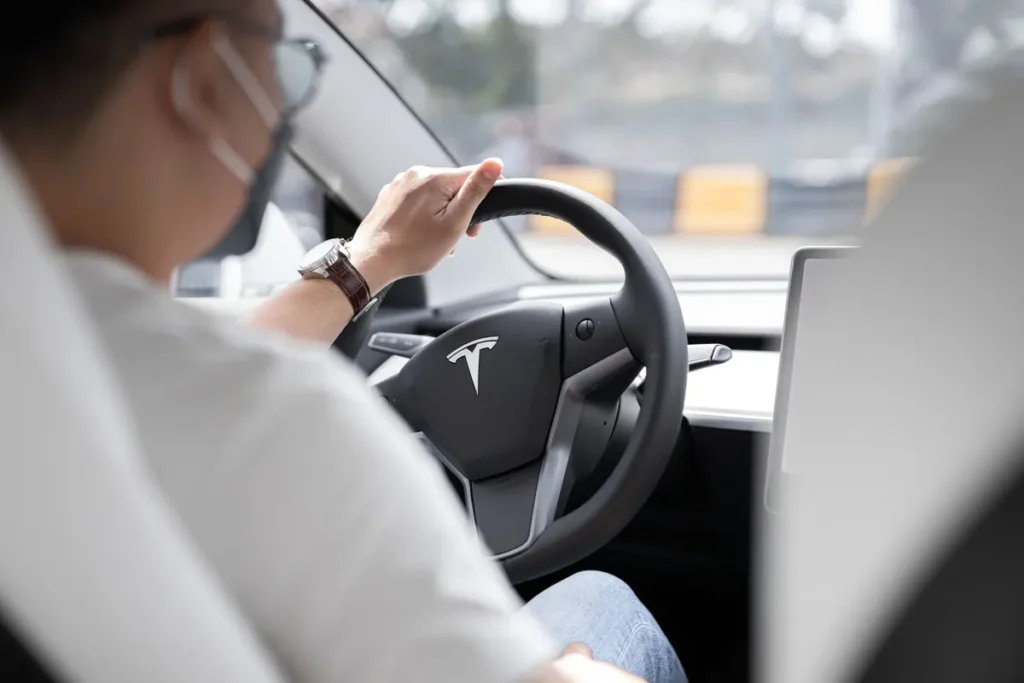
The most tangible difference between the two systems is on non-highway roads. Rivian’s system can detect traffic lights and road signs, but it does not act on them: it alerts the driver that they are approaching and hands responsibility back. Tesla’s FSD (Supervised) v14, tested over nearly 200 miles in rural Michigan and downtown Ann Arbor, handled every traffic signal, interchange and exit ramp encountered. It also managed a lorry blocking half a lane on a two-lane road, navigated several roundabouts, and parallel-parked at destinations without prompting.
The capability gap is something Rivian itself acknowledges. James Philbin, senior vice president of autonomy and AI at Rivian, described point-to-point driving (where the vehicle navigates itself from start to finish) as ‘the next big leap for us.’ The company expects to deliver that functionality later this year. Rivian’s system also cannot change lanes independently yet, though Philbin said that is coming soon.
On the highway, Rivian’s Autonomy+ performed well, requiring little intervention outside of exit ramps and some construction zones. That places it ahead of what General Motors’ Super Cruise and Ford’s highway systems currently offer, both of which remain hands-free highway-only tools. Ford and GM are working on non-highway capability, but that is not expected until 2028.
Sensor stacks, pricing and the road ahead for Rivian
One area where Rivian is betting on a future advantage is its sensor hardware. The current system uses at least 10 high dynamic range cameras, five radars and some map data. Philbin said the company also plans to add lidar, light detection and ranging, a technology that uses laser pulses to build a detailed picture of the vehicle’s surroundings, to its R2 model early next year. ‘I hope that we can even exceed the Tesla system because of our investments in a more robust sensor stack,’ he said. Tesla’s system relies on cameras alone, a ‘vision-based’ approach that has attracted criticism for its performance in low-visibility conditions such as sun glare or fog.
The National Highway Traffic Safety Administration has been escalating a probe into Tesla’s FSD (Supervised) after identifying several crashes, including one fatal incident where the system reportedly failed to alert drivers adequately about reduced-visibility conditions.
Rivian’s push on sensors is part of a broader strategy of vertical integration, developing its own software and electrical architecture in-house rather than relying on outside suppliers. Piper Sandler analyst Alexander Potter, in an investor note upgrading Rivian’s stock, wrote: ‘We favor self-reliant (and properly-valued) companies that are building next-gen machines using in-house expertise. As volume rises, Rivian should be better able to monetize software and services, a key benefit of vertical integration.’
According to IPM Newsroom, Rivian’s universal hands-free feature has already unlocked over 3.5 million miles of hands-free driving on roads across the US and Canada, a figure that illustrates how quickly the system is being used in practice. The same source reports that the company will begin producing its R2 vehicles for sale next year at its plant in Normal, Illinois, making the addition of lidar to that model a near-term commitment rather than a distant ambition.
The momentum behind that push was on display when Rivian held its first ‘Autonomy and AI Day’ on 11 December 2025 in Palo Alto, California, according to CNBC. The event signalled the company’s intent to position autonomy, not just electric vehicles, at the centre of its identity.
On pricing, the three main ADAS systems differ considerably. Tesla’s FSD (Supervised) costs $99 a month. Rivian’s Autonomy+ is $49.99 a month or $2,500 as a lifetime purchase. GM’s Super Cruise comes in at $39.99 a month or $399 a year.
Safety questions around all hands-free systems remain live. Driver-facing cameras are the industry’s primary tool for combating inattentiveness, but concerns persist around the handover moment, when the system disengages and the driver must retake control quickly. The Mercedes-Benz system is the only one currently permitted, in limited circumstances, to operate without requiring the driver to monitor it at all times. Regulation across the rest of the sector remains sparse, with each manufacturer setting its own guardrails. With R2 production scheduled to begin next year and lidar on the way, Rivian’s next software update will be worth watching closely.