
The FTSE 100 oil price fall on Thursday pushed London’s flagship index down 61.14 points, or 0.6%, to close at 10,608.92, as Brent crude surged above 105 dollars a barrel and a combination of geopolitical tension, hotter-than-expected US inflation data and a European Central Bank (ECB) rate rise left investors in a cautious mood.
Brent crude is the internationally traded benchmark for oil prices. It was quoted at 105.51 dollars a barrel at the time of the London close, up sharply from 101.07 dollars late on Wednesday.
US-Iran conflict drives the FTSE 100 oil price fall
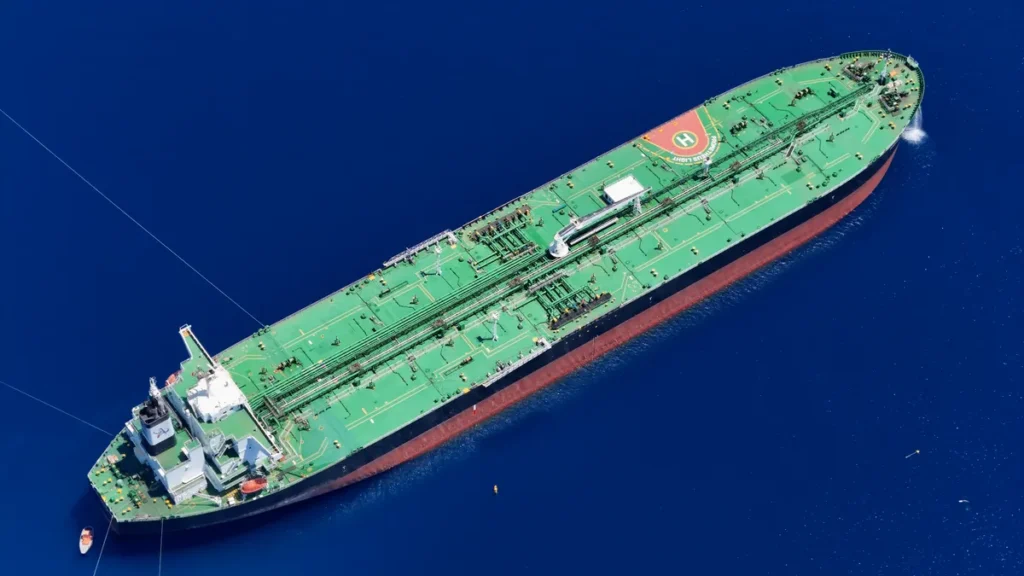
The driving force behind the oil surge was an escalation in military action between the United States and Iran. According to the Wall Street Journal, the US military struck three Iranian oil tankers after Iran launched ballistic missiles toward two Navy warships. That exchange of fire sent traders scrambling to price in the risk of disruption to some of the world’s most critical energy supply routes.
The concern is not abstract. BloombergNEF has noted that approximately 20 million barrels per day of oil transit the narrow seaway at the centre of the dispute, representing roughly 20% of global petroleum liquids consumption. Any sustained interference with that flow would send ripples through energy markets worldwide, which is precisely what traders were pricing in on Thursday.
The broader FTSE 250 index also fell, ending down 222.72 points, or 0.9%, at 23,885.94. The IM All-Share closed down 8.30 points, or 1.0%, at 787.95. In Europe, the CAC 40 in Paris fell 0.5% and the DAX 40 in Frankfurt closed down 0.7%.
ECB raises rates and revises inflation forecasts upward
Adding to the pressure, the European Central Bank raised its three key interest rates by 25 basis points (hundredths of a percentage point) on Thursday, taking the deposit facility rate to 2.50%, the main refinancing operations rate to 2.65% and the marginal lending facility rate to 2.90%. The move was the ECB’s second rate rise this year and was widely expected by markets.
ECB president Christine Lagarde described the decision as a “no-brainer” and confirmed it was unanimous. She added, however, that policymakers did not discuss any future rate decision, leaving the path ahead deliberately open.
The central bank’s updated staff projections painted a persistently elevated inflation picture. Headline inflation is now forecast to average 3.0% in 2026, 2.5% in 2027 and 2.1% in 2028, with the 2027 and 2028 forecasts both revised higher from June. Excluding energy and food, inflation is projected at 2.5% in 2026, 2.6% in 2027 and 2.3% in 2028. The ECB warned that the US war on Iran continues to generate inflationary pressure and is likely to keep price growth above its 2% target for an extended period.
On the growth side, the ECB offered a more encouraging picture, upgrading its economic forecasts and citing greater-than-expected resilience in the eurozone economy. Gross domestic product (GDP) is now expected to grow 0.9% in 2026, 1.4% in 2027 and 1.5% in 2028, with the 2026 and 2027 forecasts revised higher.
Across the Atlantic, US producer price inflation accelerated by more than expected in August. The Bureau of Labour Statistics reported that producer prices rose 5.4% year-on-year, up from 4.8% in July and above the FXStreet-cited forecast of 5.3%. Global bond yields moved sharply in response: the yield on the US 10-year Treasury widened to 4.92% from 4.81%, while the 30-year Treasury yield rose to 5.34% from 5.26%.
Stock movers: miners fall, tobacco rises, THG warns on EU duties
The FTSE 100 oil price fall was compounded by a sharp drop in industrial metal prices, which dragged London-listed miners lower. Antofagasta lost 5.7%, Anglo American fell 4.9% and Glencore shed 4.1%.
Associated British Foods sank to the bottom of the FTSE 100, losing 7.9%, after weaker-than-expected sales at Primark overshadowed plans to launch home delivery. A summer heatwave in the UK and Europe also weighed on parts of its Grocery business. Against that, tobacco companies provided some shelter: Imperial Brands topped the index, up 1.8%, followed by British American Tobacco, up 1.5%.
On the FTSE 250, THG, the parent company of Lookfantastic, Cult Beauty and Myprotein, fell 13% after warning that new European Union parcel duties, introduced from 1 July for THG Beauty, would affect third-quarter revenue growth, which it now expects at around 2%. The company described the impacts as one-off in nature and said earnings and cash generation remained “robust”.
Among smaller companies, Eleco surged 70% after the software provider focused on the construction and built environment sectors accepted a £200 million takeover offer from Accel-KKR, while Empyrean Energy jumped 80% after announcing the completion of the Duyung farm-down.
Friday’s economic diary brings UK GDP figures at 7am, with consensus expecting the economy to have been flat month-on-month in July, following 0.3% growth in June. US consumer price inflation figures, due on the same day, will set the tone for the Federal Reserve’s interest rate decision the following week.