
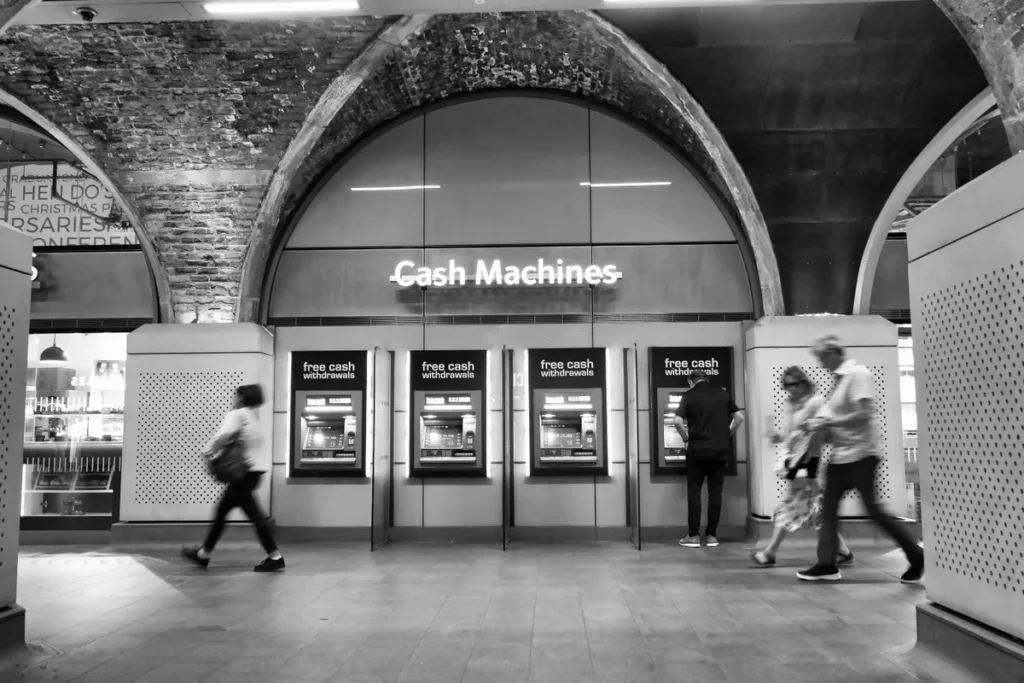
Link ATM cash withdrawals have fallen by as much as 77% in some UK city centres since before the coronavirus pandemic, with Bristol Central recording the steepest decline of any parliamentary constituency in the country, according to the ATM and cash access network Link.
Link operates the UK’s largest network of cash machines. Its data compares the first half of 2026 with the same period in 2019, before the pandemic reshaped how people shop and pay.
Which areas have seen the biggest falls in Link ATM cash withdrawals?
Bristol Central’s 77% drop in the volume of withdrawals makes it the constituency where behaviour has shifted furthest. Close behind are Holborn and St Pancras in London, the Cities of London and Westminster, Edinburgh South, Glasgow North, and Sheffield Central, all of which recorded a 73% fall in cash withdrawal volumes over the same period.
A drop of 72% was recorded in Cambridge, Edinburgh North and Leith, and Edinburgh East and Musselburgh. York Central was not far behind at 71%. In Wales, Cardiff South and Penarth saw a 70% fall in ATM withdrawal volumes.
The pattern holds across the whole country. Link said every UK parliamentary constituency has seen a reduction in both the number and value of withdrawals between 2019 and the first half of 2026. According to Link, the average constituency withdrew £1 million less in total cash from ATMs over that period. Across all UK cash machines, around £119 million less per day was typically withdrawn in the first half of 2026 compared with the equivalent months in 2019.
Not every area has shifted at the same pace. The Weald of Kent in southern England recorded a 35% fall in Link cash withdrawal volumes, and West Tyrone in Northern Ireland saw a 37% fall, declines that, while real, are roughly half the size of those seen in the largest city centres. The Independent has reported that ATM withdrawals in some parts of the UK have fallen by about 60% since spring 2019, underlining how wide the gap has become between urban and more rural areas.
Millions still depend on cash, even as contactless grows
Nick Quin, chief corporate affairs officer at Link, said the overall trend is clear but stressed that a cashless society is not yet a reality for everyone. ‘Cash withdrawals are falling across every part of the country,’ he said. ‘More people find it convenient and prefer to pay using contactless cards and digital wallets on smartphones, but millions still rely on it day in, day out.’
Quin also pointed to the uneven burden of any shift away from physical money. ‘People on lower incomes rely more heavily or entirely on cash to budget, which is why our job is to protect access to cash for as long as people need it,’ he said.
The scale of ongoing cash use is put into context by figures from UK Finance. A recent report from the trade body estimated that around 1.4 million UK adults mainly use cash for their day-to-day spending, while 19 million use cash once a month or less frequently. Cash represented 8% of all payments in 2025, down from 9% in 2024 and from 45% in 2015, according to UK Finance.
The decline in ATM use has coincided with a wave of bank branch closures across the UK. Banking hubs, where several banks share a single premises, have been introduced to help fill some of the gaps. The 250th banking hub is expected to open soon. Post Office branches also allow customers to carry out some day-to-day transactions where a bank branch is no longer nearby.
For communities where cash still matters, the figures from Link serve as a prompt to check what local access looks like. The network says its job is to make sure a cash machine remains within reach for those who need one, even as the number of people using them continues to fall.