
UK gilt yields reached their highest levels in a generation on Tuesday as UK gilt yields hit a 28-year high, driven by a sharp rise in the oil price following renewed military exchanges between the United States and Iran in the Strait of Hormuz. The FTSE 100 index closed down 34.98 points, 0.3%, at 10,789.28, while London’s mid-cap FTSE 250 (Financial Times Stock Exchange 250) fell 1.7% to 24,521.29 and the AIM (Alternative Investment Market) all-share dropped 1.9% to 796.06.
Government bonds, or gilts, are loans investors make to governments. When bond yields rise, borrowing becomes more expensive for the state, businesses and ultimately households. Tuesday’s moves pushed the yield on 10-year UK gilts to 5.22%, up from 5.15% on Friday, while the 30-year gilt hit 5.85%, up from 5.79%. The 10-year gilt earlier traded as high as 5.25%, an 18-year high, and the 30-year reached 5.89%, a level last seen in 1998.
Strait of Hormuz: Why This Shipping Lane Matters
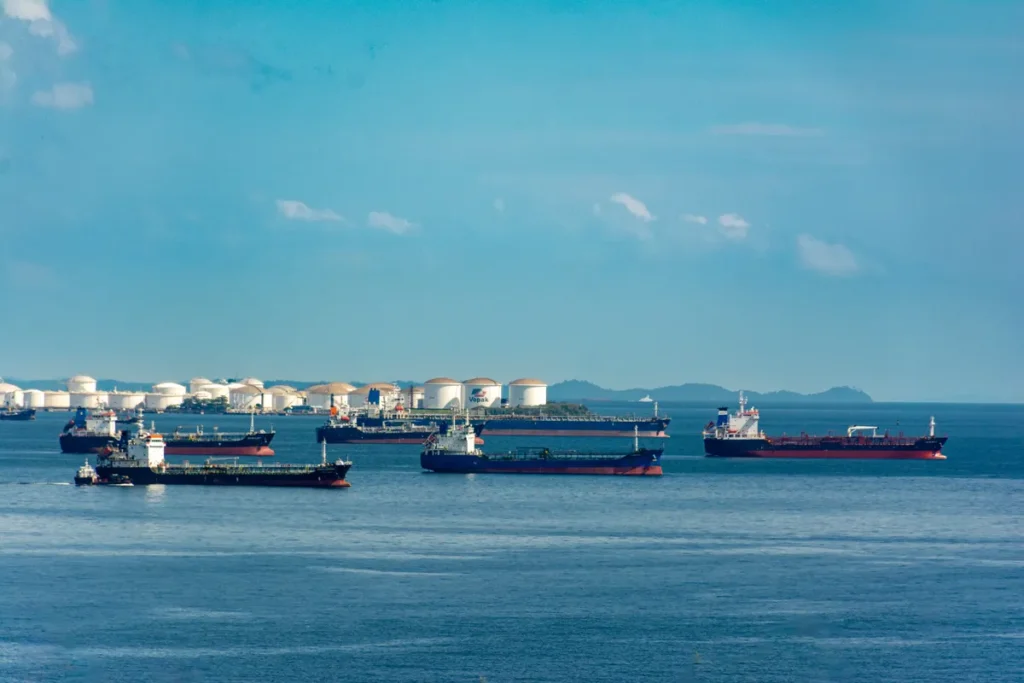
The immediate trigger was a fresh escalation in the US-Iran conflict centred on the Strait of Hormuz, a narrow waterway connecting the Persian Gulf to the Arabian Sea. According to AP News, the US military struck three Iranian oil tankers after Navy warships were targeted with missiles, marking a significant intensification of hostilities. A Greek security firm also reported that ‘unknown projectiles’ struck two additional oil tankers in the strait overnight.
The scale of what is at risk helps explain why markets reacted sharply. According to a U.S. Congress research paper, roughly 25% of the world’s maritime trade in crude oil and petroleum products, and roughly 19% of liquefied natural gas (LNG), passed through the Strait in 2025. Tehran has imposed an effective blockade of the strait since the US and Israel launched their war in late February, demanding fees for passage and attacking ships it accuses of trying to circumvent its preferred route.
A further development is now in prospect. Al Jazeera reports that Iran’s top security official, Mohsen Rezaei, has said Tehran will declare a restricted zone near the Strait of Hormuz and announce a new shipping route agreed with Oman ‘in the coming days’. Any formalised restricted zone would add another layer of uncertainty for energy markets already rattled by the disruption.
Attacks on commercial ships in the strait previously led to the collapse of an April ceasefire between the US and Iran. In response to the Iranian blockade, the US has imposed a rival blockade of Iranian ports. Brent crude for November delivery was quoted at $92.48 a barrel at the London equities close on Tuesday, up from $88.06 at Friday’s close.
UK Gilt Yields at a 28-Year High Put Pressure on the Budget
‘This renewal of hostilities threatens the destruction of energy infrastructure across the region. Add this to the Ukrainian attacks on Russian energy assets, and there’s a strong tailwind for oil prices,’ said David Morrison, senior market analyst at Trade Nation.
The strain on gilts has direct consequences for the public finances. Kathleen Brooks, research director at XTB, said the rise in bond yields poses a ‘major challenge’ for the Chancellor ahead of next month’s Budget. ‘Every basis point increase in the cost of borrowing in the UK adds to debt servicing costs, which needs to be paid by the public purse. Since the spring, the UK’s interest-only bill has risen by up to £6 billion by the end of this parliament. This is a large hole for the Chancellor to fill next month,’ she said. A basis point is one-hundredth of one percentage point.
In the US, the yield on the 10-year Treasury widened to 4.77% from 4.68% on Friday, while the 30-year Treasury reached 5.25%, up from 5.18%. Susannah Streeter, chief investment strategist at Wealth Club, described it as ‘an unsettling start to September, with the mood tested by renewed conflict between the US and Iran, keeping worries bubbling about high energy costs, inflation and debt, and the knock-on effect on growth.’
European equity markets also fell, with the CAC 40 in Paris closing down 0.4% and the DAX 40 in Frankfurt ending 1.1% lower. In New York, the Dow Jones Industrial Average fell 0.4%, the S&P 500 dropped 0.5%, and the Nasdaq Composite fell 0.7%. Eurostat figures showed eurozone annual consumer price inflation accelerated to 3.3% in August from 2.9% in July, the highest rate since September 2023, ahead of a European Central Bank (ECB) meeting next week at which the ECB is expected to raise interest rates by 25 basis points.
On the FTSE 100, energy companies benefited from the higher oil price: BP rose 5.2% and Shell gained 2.6%. Mining stocks fell, with Endeavour Mining down 5.4%, Antofagasta down 5.2% and Fresnillo down 4.9%. Reckitt Benckiser climbed 4.4% after a US jury voted unanimously in the company’s favour in a case related to necrotising enterocolitis (NEC) litigation against its baby formula division, Mead Johnson. AJ Bell investment director Russ Mould said the ruling ‘removes a significant area of doubt surrounding the business which could help clear the way to a sale [of Mead Johnson] which Reckitt has been pursuing for some time’.
On the FTSE 250, Bodycote rose 4.6% after accepting a £1.65 billion offer from Veritas Capital Fund Management, valuing each share at 940 pence. Rival bidder CVC Advisers said it is ‘considering its position’. Capricorn Energy jumped 9.6% after recommending a cash takeover offer from Norway’s DNO ASA at $4.224 per share plus a special dividend of $0.99, for total consideration of $5.214 per share, a 10% premium to a competing proposal from Genel Energy. Wednesday’s calendar includes an interest rate decision in Canada, US ADP payrolls data and the Federal Reserve’s Beige Book.