
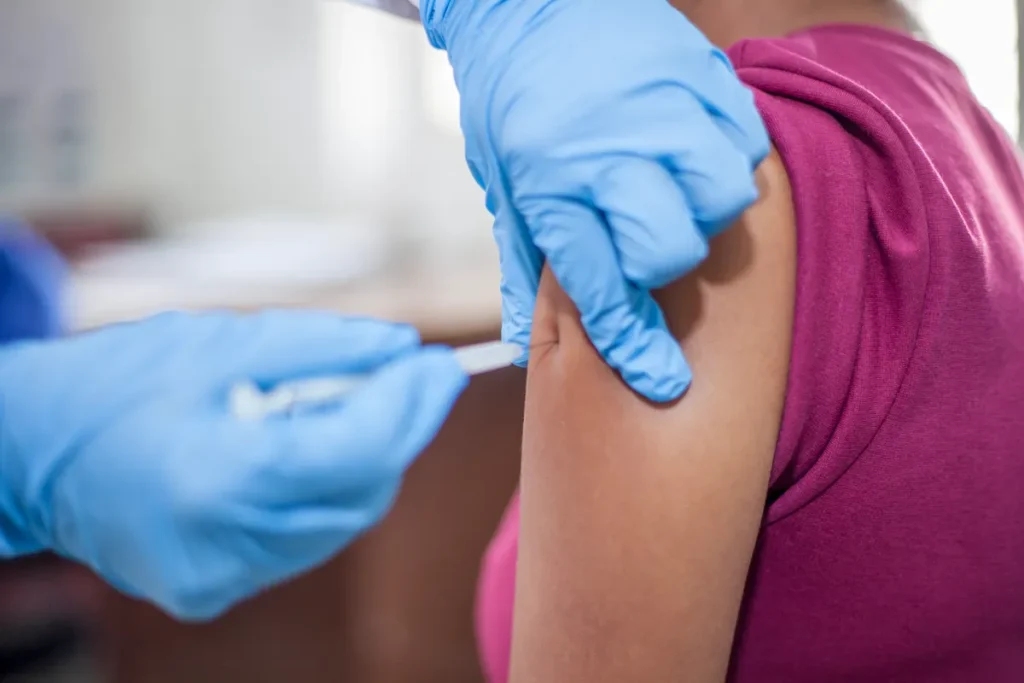
The biggest obstacle to containing vaccine-preventable diseases in the United States may not be the hard-core anti-vaccine movement, it is the US vaccine hesitancy middle ground, a large share of the population that is genuinely uncertain about immunisation and struggling to filter conflicting information. A survey released in July by KFF (KFF is a health policy research organisation, formerly known as the Kaiser Family Foundation) puts that uncertain group at 31% of the US public, comprising people who give a mixture of true and false responses to common vaccine myths and land on a “probably” answer at least half of the time.
That 31% sits between two clearer camps. Consistent myth deniers, people who say all four vaccine myths the KFF survey tested are false, with at least three of the four marked as “definitely false”, make up 29% of the public, according to the same KFF poll. At the other end, fewer than one in ten respondents said any single vaccine myth was definitely true. The majority of Americans, in other words, are not committed opponents of vaccination; they are stuck somewhere in an uncertain middle, unsure who or what to believe.
What the numbers reveal about the US vaccine hesitancy middle ground
“What’s more true is a lot of people are confused,” said Drew Altman, KFF’s CEO and founding president. “They don’t know who to believe, they don’t know what to believe, and that means that a lot of America is stuck in the middle, unsure and they’re up for grabs.”
The consequences for childhood immunisation are already visible. News Medical reports that nearly half of parents who said they had skipped or delayed recommended childhood vaccines fell into that mixed-middle category, suggesting that uncertainty, rather than firm opposition, is driving many decisions to hold back on immunising children.
The broader vaccination data underlines why that matters. The Centers for Disease Control and Prevention (CDC) reports that the US has recorded 2,777 confirmed measles cases and 36 new outbreaks across 47 jurisdictions this year, a 35-year high. Childhood vaccination rates have slipped to about 92% for kindergartners, while non-medical exemptions reached a record high of 4.2% during the 2025-2026 school year, representing an estimated 155,000 children nationally. More than 93% of those infected with measles this year are unvaccinated or have an unknown vaccination status, the CDC said.
Jess Steier, a public health scientist and founder and CEO of Unbiased Science, which specialises in making complex scientific concepts understandable, said even small dips in coverage carry risk. “Even little dips in that coverage could lead to more of a highly contagious virus like measles circulating,” she said. Crucially, she added that uncertainty can be addressed: “Uncertainty can resolve once people have time, information and access.”
Why confusion spreads, and how public health officials are responding
Steier’s organisation developed a framework called “LANDS” to categorise the different drivers of vaccine hesitancy. The five groups it identifies are: “Lost” (confused by conflicting information), “Anxious” (worried about side effects), “Naturalists” (sceptical of medical interventions), “Distrusters” (suspicious of institutions broadly), and “Shruggers” (not opposed but not prioritising vaccination). The LANDS framework was developed specifically for pharmacists in partnership with the National Alliance of State Pharmacy Associations, reflecting the fact that most adult vaccinations now take place in pharmacies.
Dr Lori Handy, an attending physician and associate director of the Vaccine Education Center at Children’s Hospital of Philadelphia, cautions against expecting people to fit neatly into any single category. “The factors that play into either having questions or having hesitancy about vaccines are really complex and are coming together as this combination of social factors, religious factors, access factors and who’s on their Instagram feed,” she said.
The political environment has made the challenge harder. Trump this month signed an executive order suggesting the MMR (measles-mumps-rubella) vaccine be split into separate shots, falsely claiming the combined version is “quite lethal” and linking it to autism. Health and Human Services Secretary Robert F. Kennedy Jr. has a well-documented history of spreading scientifically inaccurate information about vaccine safety, even while saying he is not “anti-vaccine”. Handy said that type of rhetoric from figures of authority makes parents “less and less likely to vaccinate their child.”
Both Steier and Handy agree that the path forward starts with listening rather than lecturing. Dismissing people’s concerns outright, or ignoring that many now turn to platforms such as TikTok for health information, is counterproductive. Providers should help people compare what they find online with evidence from trusted medical sources, Handy said, and keep conversations open rather than prescriptive.
Handy also points to a structural problem: vaccines have become, in a sense, victims of their own success. Because measles was largely eliminated for decades, many parents have never seen the illness and do not perceive it as a serious threat. With the US now recording a 35-year high in measles cases, she argues that framing needs to shift. “We’re in a different period with a different risk profile that people need to understand for their child,” Handy said. “Times have changed, and we need to really keep their child safe.”