Chinese Investment in London Property Left Ghost Neighbourhoods and Billion-Pound Holes
Chinese investment in London property shaped the capital’s skyline for more than a decade, and its withdrawal has left behind empty offices, stalled towers and, in one case, a finished street with nobody in it. The story of how that happened, and what London is left with, is only now coming fully into view.
Between roughly 2008 and 2016, Chinese capital poured into London at a pace that surprised even property veterans. One agent described it as ‘a buying frenzy, when the Chinese were buying everything, and I mean everything.’ Commercial property prices had fallen sharply after the 2008 financial crash, making London an attractive destination for capital that Chinese state-owned banks were actively encouraged to send abroad. Iconic sites near Canary Wharf and the Bank of England were particular favourites, all marketed with promises of jobs and new housing for Londoners.
How Chinese Investment in London Property Unravelled
The mood shifted around the time the UK voted to leave the European Union. No longer a gateway to the single market, London became a less useful place to park Chinese capital. Then, in 2020, China moved to rein in its own debt-fuelled property bubble, tightening regulations on developers’ debt-to-asset ratios. Suddenly, Chinese firms operating in London were running short of money and falling foul of new rules at home. Analysts at Bloomberg estimate that between 2017 and 2022, UK real estate deals by mainland Chinese investors fell by 88 per cent.
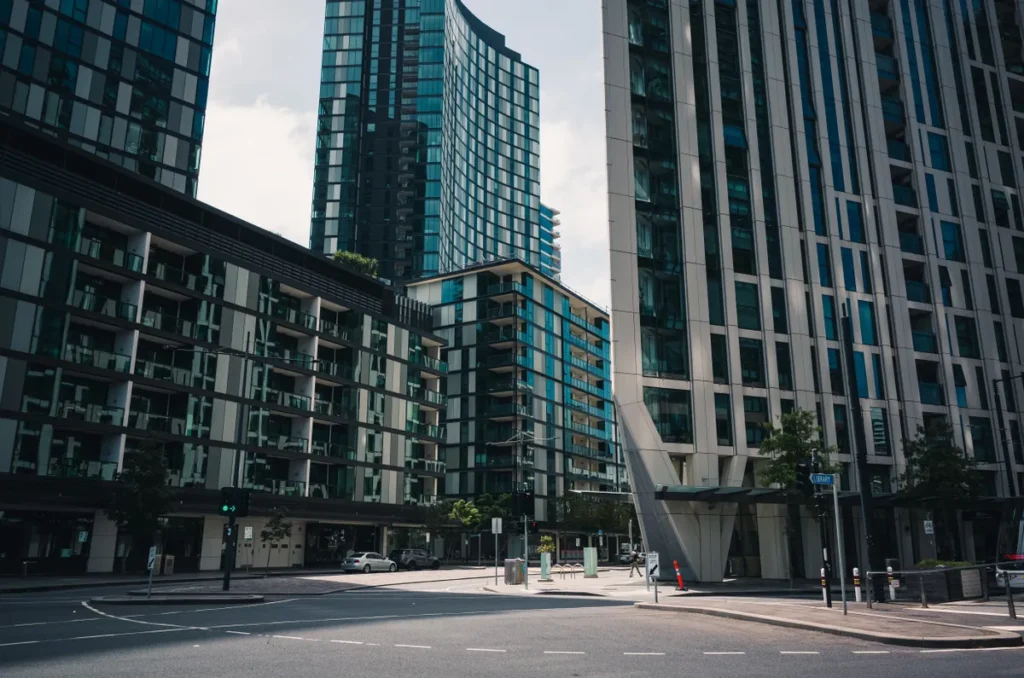
The damage is visible in specific sites across the city. One Nine Elms, near Vauxhall, was meant to be a centrepiece of London’s boom years: a £900 million development of 58- and 43-storey towers built by Dalian Wanda and later Guangzhou R&F. Construction workers walked off the job in 2022 when R&F failed to pay them. According to Crosstree Real Estate Partners, R&F eventually agreed to offload the mixed-use project for £640m to CC Land, headed by Cheung Chung-kiu. The towers have since been completed under the new ownership.
The wider Nine Elms area has seen further transactions. At the Thames City development, also in Nine Elms, 495 units have been sold for a combined £989m, according to Bisnow. That figure shows that some London schemes tied to Chinese-backed capital have found a way through, even if through ownership changes and delays that stretched over years.
Not every project has reached even that point. The Spire, a 67-storey tower in Docklands bought by Greenland in 2014 and intended to be the tallest residential building in Western Europe, remains a hole in the ground more than a decade later. Greenland and Tower Hamlets council are still in dispute over whether the development can satisfy both the company’s profit margins and the council’s fire safety requirements.
A Ghost Neighbourhood on the East London Waterfront
The most complete example of the golden era’s failure sits at Royal Albert Dock in east London. Advanced Business Parks (ABP) took over 35 acres of waterside land opposite London City Airport, promising an Asian Business Park that would create 20,000 jobs and add £6bn to the UK economy. Construction stopped in 2019 when ABP failed to pay its creditors. By 2022, Sadiq Khan had torn up the £1 billion agreement with ABP, after what critics called a ‘wasted decade.’ What remains are handsome six-storey brick buildings, finished on the outside but hollow inside, standing silent on Mandarin Street. Next to them, a large section of waterside land stretches unbroken to the University of East London: ABP never broke ground on phase two.
The Greater London Authority never kept a full record of how much Chinese money entered London during the boom, so the total scale of the losses is hard to quantify. What the city can count is the result: of London’s 391 developments currently in progress, eight large residential and commercial sites developed by five Chinese developers are listed as either still under construction or halted part-built.
The super-embassy row at Royal Mint Court in Tower Hamlets, where the People’s Republic of China paid £255m for the freehold in 2018, added a further layer of political difficulty. Tower Hamlets planners rejected the embassy proposal in 2022 and again in 2024. Steve Reed approved the scheme in January 2026, on the eve of Sir Keir Starmer’s visit to China. An appeal against planning permission is still pending, and building work has not yet begun.
London is not simply waiting for a clean break from Chinese investment: nearly 152,000 Chinese students study at UK universities, and Chinese capital remains embedded in the city’s infrastructure and businesses. The outstanding question is how to accelerate the rehabilitation of the sites that were left behind, and whether the projects still stalled can find new developers willing to finish what was started.