Chinese Investment in London Property Left Ghost Neighbourhoods and Stalled Towers
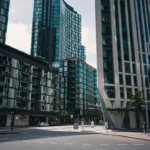
Chinese investment in London property transformed the capital’s skyline between 2008 and 2016, then retreated, leaving behind empty offices, a ghost neighbourhood at Royal Albert Dock, and towers that stood unfinished for years. The story of how that happened (and what it cost) is written into the landscape of the city today.
Chinese capital, much of it channelled through state-owned banks, flooded into London following the financial crash of 2008, when commercial property prices had fallen sharply. The Greater London Authority did not track how much arrived or where it landed, though commercial bodies attempted to trace it. Sites near Canary Wharf and the Bank of England were particularly attractive, and developers marketed them with promises of jobs and housing for Londoners.
How Chinese Investment in London Property Took Hold
The volume of activity during that period was extraordinary. In 2013, Dalian Wanda began work on a commercial-residential development at One Nine Elms near Vauxhall. That same year, Beijing-based Advanced Business Parks (ABP) took on 35 acres of waterside land at Gallions Reach, opposite London City Airport, with plans for an Asian Business Park. In 2014, Shanghai developer Greenland bought a Docklands site at Westferry to build a 67-storey tower called The Spire. High-profile visits between London and Beijing (involving David Cameron, George Osborne and Boris Johnson in 2010, 2013 and 2015) helped sustain the mood. Xi Jinping visited London in 2015. Johnson also set up London & Partners, funded by taxpayers, with offices in Beijing, Shanghai and Shenzhen to promote inward investment.
The Chinese Communist Party at that time encouraged outward investment of capital it could not absorb domestically. London’s cash-strapped councils, supported by central government, eagerly took the money. A property agent described the period to Caroline Knowles, writing in The London Standard, as ‘a buying frenzy’ when ‘the Chinese were buying everything. And I mean everything.’
The Collapse and the Cost of Chinese Investment in London Property
Around the time the UK voted to leave the European Union, Chinese investment in London development began to collapse. No longer a gateway to the EU, Britain became a less attractive place for Chinese capital. At home, China’s debt-fuelled property bubble was approaching bursting point by 2020, and Beijing tightened regulations on debt-to-asset ratios, making it harder for developers to borrow and complete overseas projects. Analysts at Bloomberg estimate that UK real estate deals by mainland China investors fell 88 per cent between 2017 and 2022, with the drop in development-site deals estimated to have gone even further.
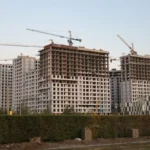
One Nine Elms became the most visible casualty. Construction workers left in 2022 after Guangzhou R&F Properties failed to pay them, leaving the 58- and 43-storey towers incomplete. R&F had itself bought the site from Dalian Wanda after Wanda ran into its own liquidity problems. According to Crosstree Real Estate Partners, R&F agreed to sell the mixed-use project to CC Land for £640m, a steep discount to its valuation of more than £1bn at the end of December. The same source reports that in the second quarter of 2022, R&F sold its 50% stake in the Thames City development in Nine Elms to CC Land for £270m, representing a £190m loss on its initial investment. R&F bought the luxury project from Wanda Group in 2018, according to Yicai Global, which also reports that the sale to CC Land involved a special-purpose vehicle owned by Cheung Chung-kiu that would shoulder at least USD800 million of bond principal. The towers, known as River Tower and City Tower, have since been completed under CC Land’s ownership.
The Spire at Westferry remains, after more than a decade, nothing more than a hole in the ground. Greenland is in dispute with Tower Hamlets council over profit margins and fire safety requirements, and no resolution is in sight for Londoners waiting for housing that was promised years ago.
At Royal Albert Dock, ABP built 56,000 square feet of office, retail and residential space across three rows of six-storey brick buildings before construction stopped in 2019 when the company failed to pay its creditors. In 2022, Sadiq Khan cancelled the £1bn agreement with ABP after what critics called a ‘wasted decade’. The buildings are finished on the outside but empty inside. Outside on Mandarin Street, nothing moves. The hole beside them, intended as phase two of a project that promised 20,000 jobs and £6bn for the UK economy, was never even broken ground.
Big investors including China Vanke Co and Fosun International Holdings sold London office properties between 2017 and 2022. In 2023, Shimao Group Holdings sold its office building previously occupied by Goldman Sachs. Of London’s 391 developments currently in progress, eight large sites developed by five Chinese developers are listed as still in construction or halted part-built. The £900m One Nine Elms development’s troubled history illustrates, perhaps most sharply, the gap between the promises of the golden era and what actually landed on the ground. An appeal against planning permission for the Chinese super-embassy at Royal Mint Court is still pending, and building work there has not yet begun.